Halt Aging Now!
Telomeres -- Programmed to die!
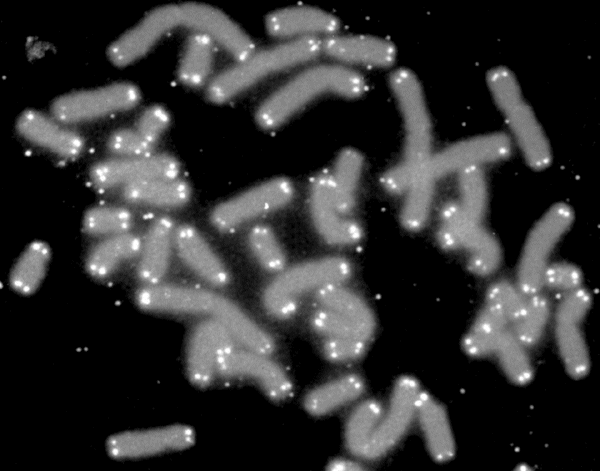
Scientists observe that the length of telomere chains becomes shorter as we grow older. Eventually the telomeres become so short that cell replication produces lethal errors or missing pieces in the DNA sequence, ending the cell's ability to replace itself. This point, when the cell has lost vital DNA code and cannot reproduce, is called the Hayflick limit. It's the measure of how many times a cell can copy itself before it dies. We at Chronos DNA Inc. are working on a solution to stop the deterioration of telomeres, thus halting the aging process.
Some cells in our body have a very high hayflick limit. Cells that line the inside of your mouth and intestines, for example, are constantly being worn away and replaced. Indeed these cells appear to have the ability to regrow telomeres even in aged bodies. Scientists were curious why some cells shut down telomere growth with age, and some do not.
The protein factors responsible for stabilizing the ends of chromosomes are being identified, cloned, and studied. Electron microscopy is used to directly visualize the structure of the model telomeres. There are new enzymatic assays to determine the structure of telomere DNA in normal and abnormal cells grown in vivo and in vitro, in order to address specific hypotheses about the role of telomeres in aging and cancer. It's exciting research, for sure, and there have been some promising discoveries.
Scientists have discovered an important enzyme that can turn the telomere production on the DNA molecule "on" and "off." It's called telomerase. Not surprisingly, it seems that as we get older, the amount of telomerase in our cells decreases.